
Written by Mia Pope, with AI-assisted research and editing
A client of mine came to me a few weeks ago with a familiar story. She’s 56. By most measures, she’s more active than people half her age: swimming, hiking, dancing, some yoga, tennis several times a week for years. Then tennis elbow showed up.
In the initial consultation, she told me what she wanted. Strengthen around the injury. Prevent the next one. Keep doing all of it, for a lifetime, in her words.
When I asked her the question I put in every intake record, what is your goal, she joked that she wants to be strong forever, until she dies.
I laughed. She laughed at the same time. I’m still not entirely sure why.
I’ve met a lot of clients in my career. She’s one of the rarest. I’ve never heard that reason from anyone else. Most people come to me with something like: I want to get back to my fitness routine. I want to lose weight, lose fat. I want to get stronger so I can walk or run better. Or, my doctor told me I have osteopenia, osteoporosis, low bone density, low muscle mass, pre-diabetes.
Those are all good reasons to see a personal trainer. But I think we laughed because most people actually want to be strong forever too. We just never say it out loud, the way she did.
I’ve also noticed people’s fitness goals have changed. Most of my clients now aren’t chasing the aesthetic look, that’s surface-level. They look at fitness more like a tool, something that helps them enjoy their daily life and the recreational activities they love. She’s not exceptional in that. She came to me because she wants to still be playing tennis, still be hiking, still be dancing, ten and twenty years from now. That’s the coaching problem I find most rewarding to solve.
Before I programmed anything, I did what I always do. I asked what her sport actually demands, and what it quietly breaks down in the process.
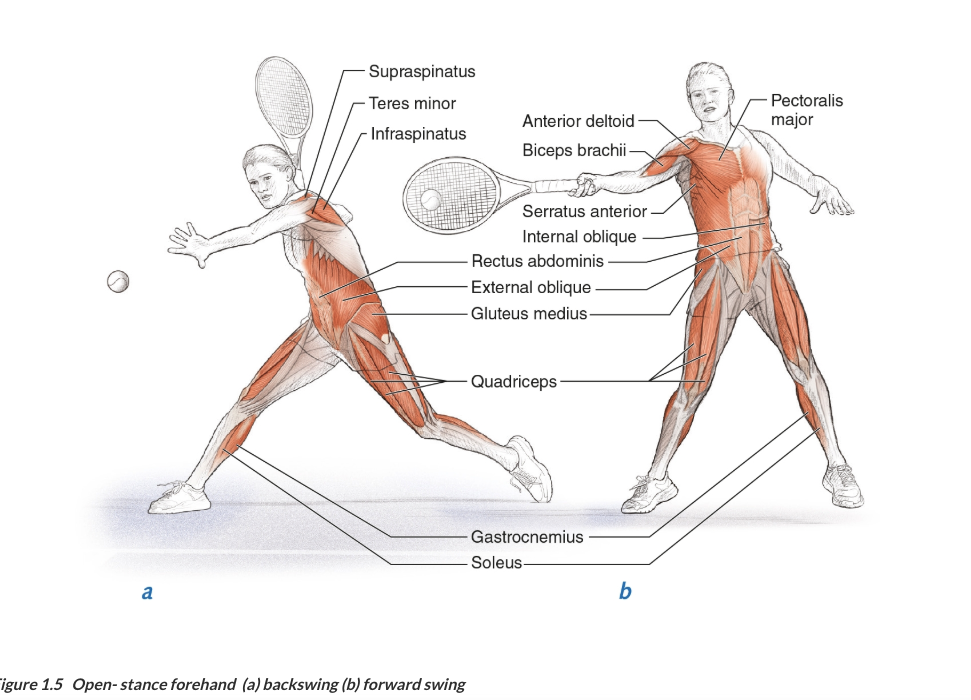
Here’s how I analyze the muscle work behind each movement in tennis, and why playing for years without strength training leads to imbalance, tight muscles, and spasms.
Tennis players develop a very specific, predictable imbalance, and it comes straight from the swing. Every forehand, backhand, and serve pulls the racquet through the same motion: the arm rotates inward, the chest and shoulder drive forward. Do that thousands of times a season, and the muscles behind that motion (the pecs, lats, upper traps, and the internal rotators of the shoulder) get strong and tight from constant use.
The muscles on the other side of that equation don’t get the same workout. The serratus anterior, the lower trap, and the external rotators of the shoulder (together called the posterior cuff) are supposed to stabilize the shoulder blade and rotate the arm the opposite way. But tennis rarely asks them to do that job, so they quietly fall behind.

1. What Tennis Actually Does to a Body Over Time
Over enough years, that imbalance shows up somewhere. For my client, it showed up as tennis elbow. And during our very first session, on something as simple as a rowing machine, it showed up as a sharp spasm under her shoulder blade. Right where this pattern usually concentrates.
She also mentioned something she’d been living with much longer: low back pain that had followed her since she was 19, reliably triggered by playing tennis. It ties into the same shoulder issue, really. Rotational sports load the spine unless you deliberately teach the body to generate that rotation from the hips and trunk instead.
2. Why I Didn’t Just Tell Her to Stretch It Out
The instinct with tight, overworked muscles is to stretch them and move on. That’s incomplete. A muscle that’s chronically overactive is usually overactive because something else, often its opposing muscle group, isn’t doing its job. Stretch the tight side without waking up the weak side, and you’re back to the same imbalance a few weeks later.
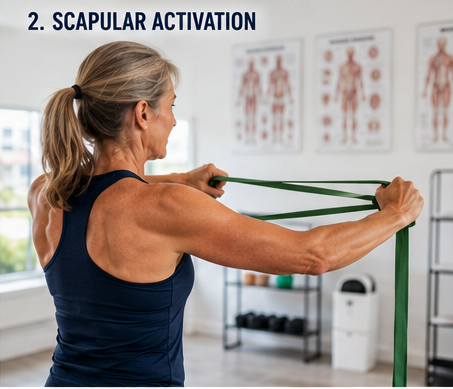
So the first phase of her program focuses on restoring control before we add any load. Thoracic mobility work. Scapular activation drills that specifically target the serratus anterior and lower trap. A slow, deliberate reintroduction of the exercises that triggered the spasm in the first place, testing them at a very light load, watching how her shoulder blade moves, only progressing once that movement is clean.
For the elbow, the research on tennis elbow (lateral epicondylitis) is pretty clear. Rest alone doesn’t fix it. Progressive, tolerable loading of the wrist extensors, starting isometric, then adding eccentric work, is the first-line approach. That’s what we’re doing, at an intensity that never crosses into pain.
For the back, the evidence-based approach means staying active. Building trunk control (think dead bugs, bird dogs, anti-rotation work). Gradually reintroducing the movements she’s afraid of, instead of avoiding them altogether.
3. The Three-Month Arc
I built her program in three phases instead of handing her a single plan and hoping it holds up.
Weeks 1 through 4 are about calming things down and rebuilding the control that’s gone missing: scapular work, gentle core stability, isometric loading for the elbow, a cautious and monitored return to the exercises that flared her up.
Weeks 5 through 8 add real strength back in: posterior chain, rotator cuff, hips and glutes, and the kind of full-body strength training that matters most for bone health at this stage of life, once the corrective work has done its job.
Weeks 9 through 12 turn that strength into something tennis-specific: hip-and-trunk-driven rotational power instead of arm-driven power, deceleration and change-of-direction work, a structured ramp back into full tennis volume instead of jumping straight back into match play.
4. The Part Most Training Plans Skip
None of this works if she doesn’t do the small stuff between sessions. Realistically, a busy, active person is not going to carve out a separate 20-minute “corrective exercise” block most days. So instead of asking her to add something new to her day, we anchored the tiny behaviors to things she already does without thinking.
After she gets back in the car post-tennis, she does two slow shoulder-blade squeezes. After she brushes her teeth in the morning, 30 seconds of thoracic extension over a rolled towel. Before she picks up her racquet, five slow scapular rotations as a warm-up ritual. None of it takes willpower. It just rides on a routine she’s already running every day.
That’s the behavior design piece. In my experience, it’s why a program actually gets done instead of just looking good on paper.
5. Why This Matters Beyond One Client
If you’re active the way she is (tennis, pickleball, golf, anything repetitive and one-sided), this pattern is worth knowing about before it shows up as pain. The muscles doing the visible work are rarely the ones that need the most attention. It’s almost always the quiet stabilizers in the background that decide whether you’re still playing in ten years, or nursing the same injury on repeat.
That’s the whole aim of strength training built around a real sport and a real life. Protecting the things you love doing, instead of chasing a number on a scale.
Now I coach clients like her to build programs around the sport they refuse to give up, not just strength for its own sake.